 English
 Español
 Français
 Deutsch
 Português (Brasil)
 Русский
 العربية

PPGI Steel Coil Manufacturer | Color Coated Galvanized Steel
 China

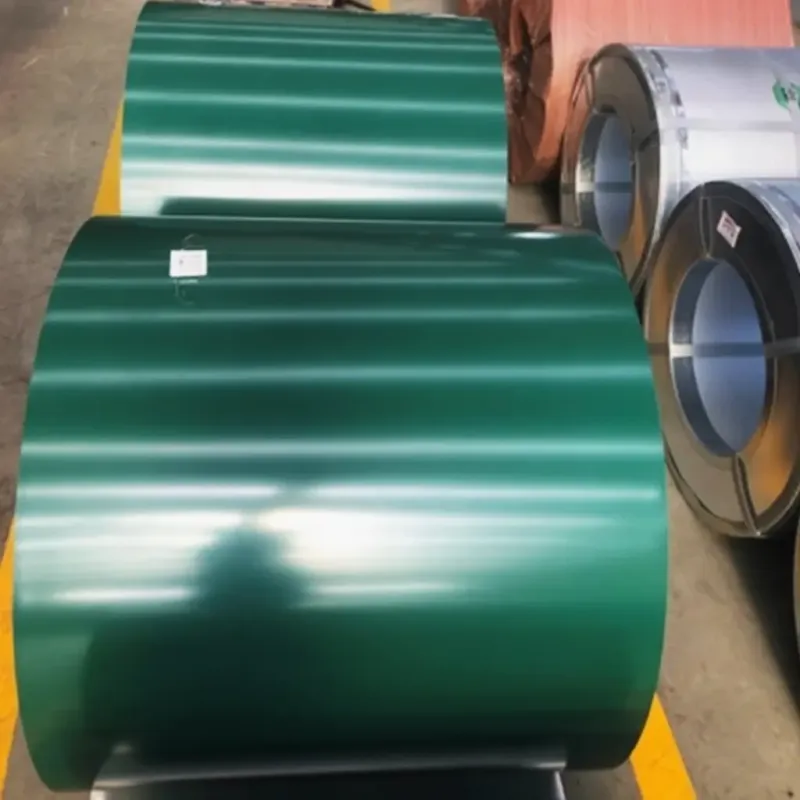
Supplier's customization ability
- Drawing-based customization
- Sample-based customization
- Full customization
Minimum order quantity: 25 ton
Shipping total: To be negotiated
- Lead time:
- confirmed with the quotation
- Packaging:
- standard export packing
- Samples:
- available on request
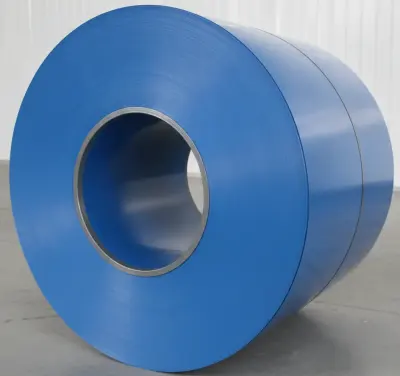
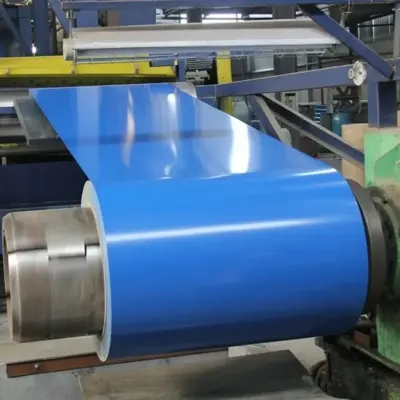
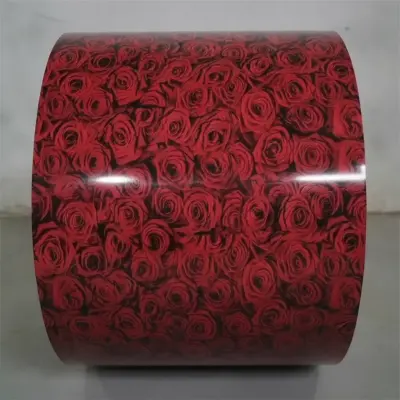
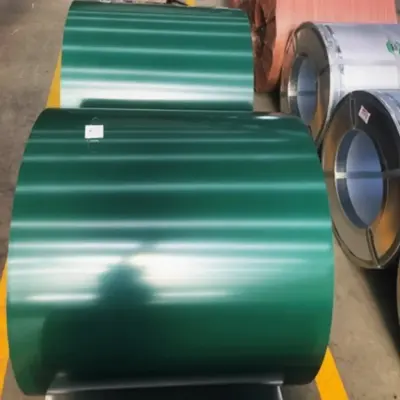
Product details
PPGI Steel Coil Technical Specifications
| Product Attribute | PPGI Steel Coil Specification |
|---|---|
| Product Name | PPGI Steel Coil (Pre-Painted Galvanized Steel Coil) |
| Base Metal | Hot-Dip Galvanized Steel Coil (GI) |
| Applicable Standards | ASTM A755/A755M, ASTM A653/A653M, EN 10169, EN 10346, JIS G3312, GB/T 12754 |
| Steel Grades | DX51D+Z, DX52D+Z, DX53D+Z, S220GD+Z, S250GD+Z, S280GD+Z, S320GD+Z, S350GD+Z, SGCC, CGCC, CS Type A/B/C |
| Thickness | 0.12-2.00 mm (customizable) |
| Width | 600-1,500 mm (customizable) |
| Zinc Coating | Z30-Z275 g/m² |
| Top Paint Thickness | 10-35 μm, typically 15-25 μm |
| Back Paint Thickness | 5-20 μm, typically 5-10 μm |
| Coating Structure | 2/1, 2/1M, or 2/2 coating system |
| Paint Types | PE, SMP, HDP, PVDF, and PU |
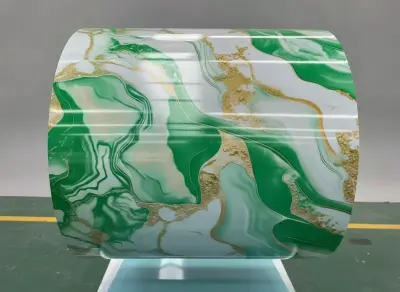
| Surface Finish | Glossy, matte, wrinkle, textured, embossed, printed, or wood-grain finish |
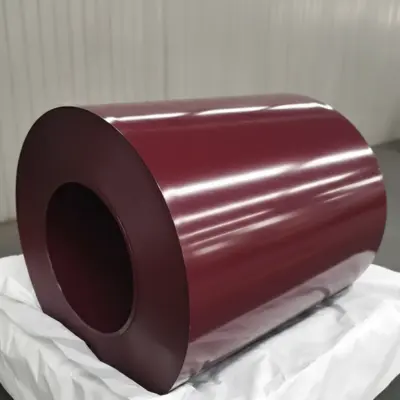
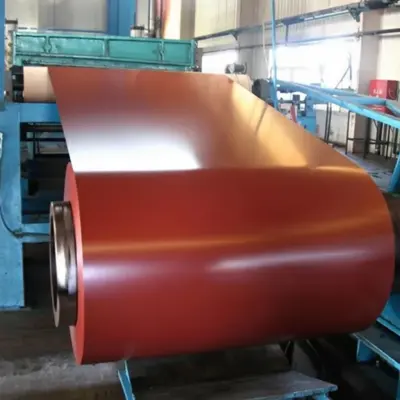
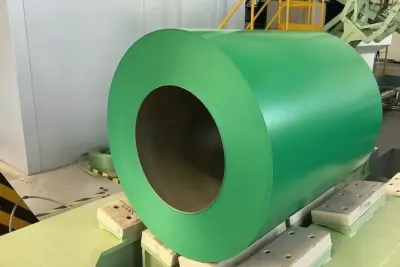
| Available Colors | RAL color system or customized color samples |
| Gloss Level | Low, medium, or high gloss; typically 20-80 GU |
| Coil ID | 508 mm or 610 mm |
| Coil Weight | 2-10 metric tons per coil or as required |
| Yield Strength | 140-550 MPa, depending on steel grade |
| Tensile Strength | 270-570 MPa, depending on steel grade |
| Surface Protection | Protective film available upon request |
| Key Properties | Excellent corrosion resistance, weather resistance, formability, color retention, and decorative appearance |
| Typical Applications | Roofing sheets, wall cladding, sandwich panels, ceilings, garage doors, home appliances, HVAC ducts, and prefabricated buildings |
| Edge Condition | Mill edge or slit edge |
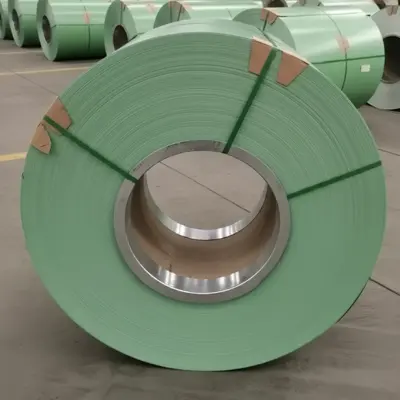
| Packaging | Seaworthy export packing with waterproof paper, steel sheet protection, edge protectors, and steel straps |
| Customization | Thickness, width, zinc coating, paint system, color, gloss, surface pattern, coil weight, and packaging can be customized |
PPGI Steel Coil Manufacturer | Color Coated Galvanized Steel
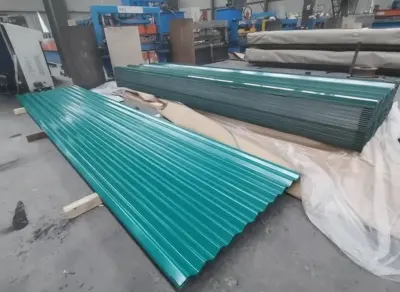
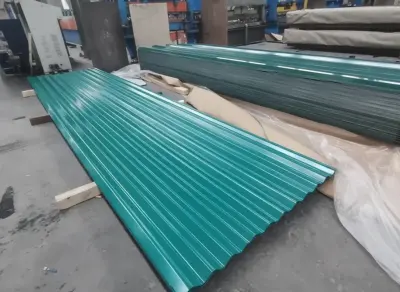
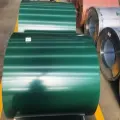
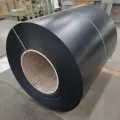
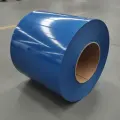
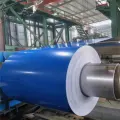
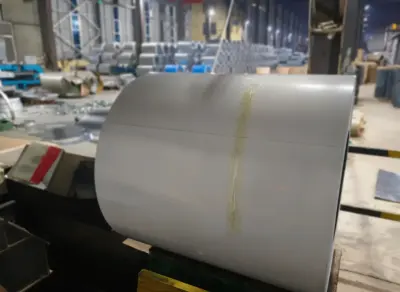
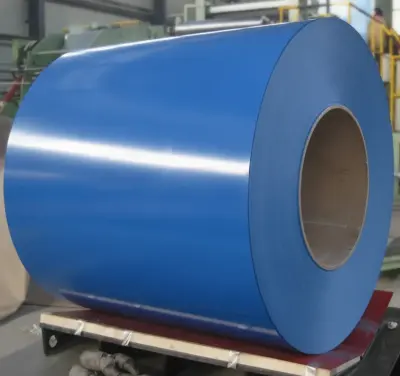
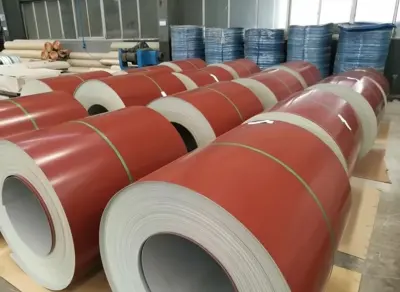
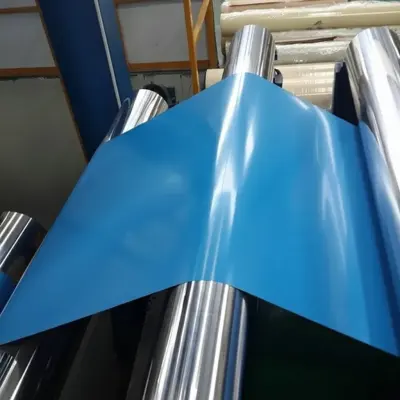
PPGI Steel Coil is a factory-painted galvanized steel product designed for roofing, wall cladding, appliances, doors, ductwork, and general fabrication. It serves overseas distributors, roll-forming companies, building-material suppliers, OEM manufacturers, and project contractors that require corrosion protection, consistent color, and efficient downstream processing. By combining a zinc-coated steel substrate with chemically pretreated primer and finish-paint layers, PPGI reduces the need for painting after forming. Buyers can specify the substrate grade, zinc coating, dimensions, paint system, color, gloss, surface texture, and packaging according to the intended environment and applicable international standard.
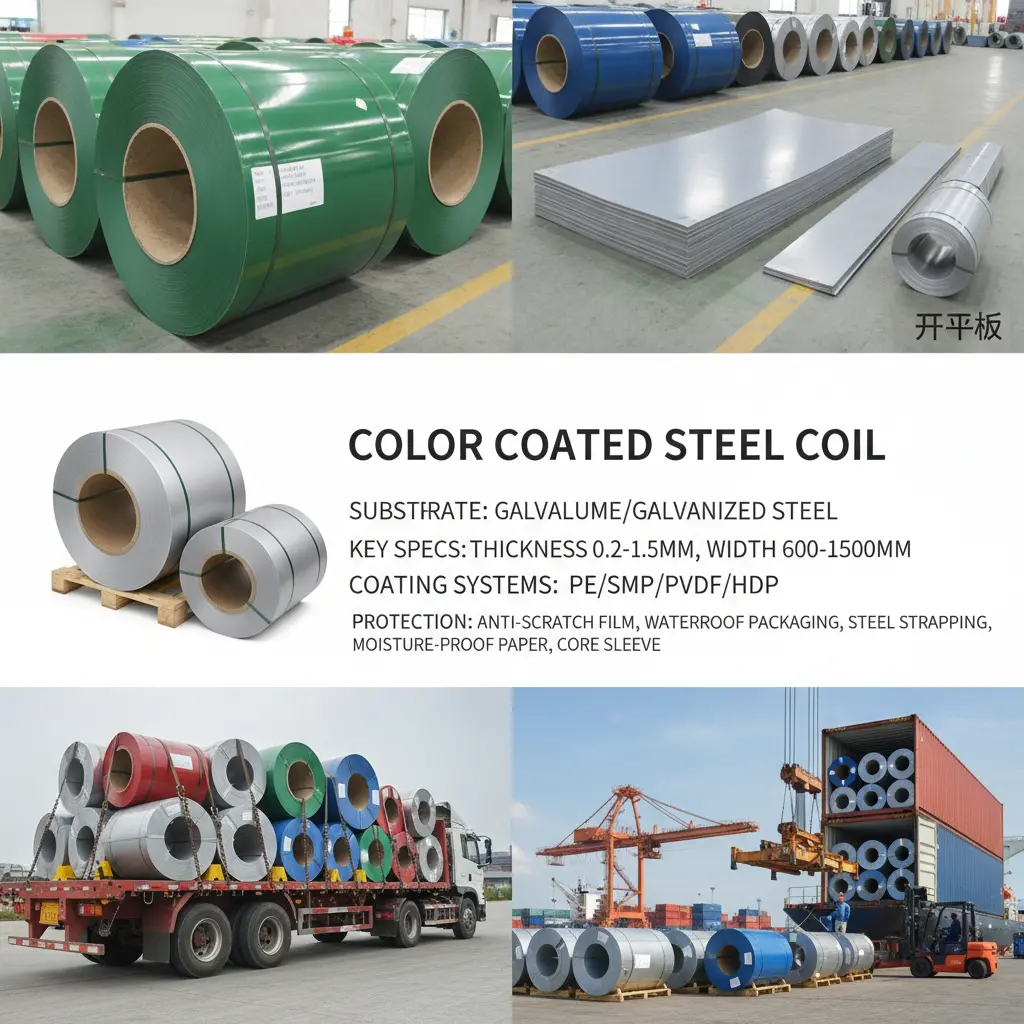
PPGI Steel Coil Product Overview
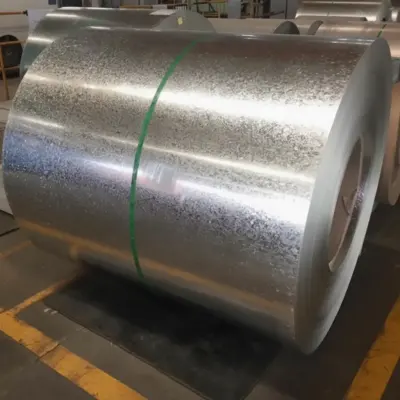
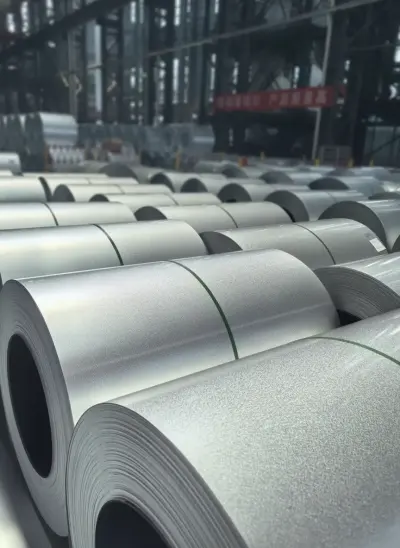
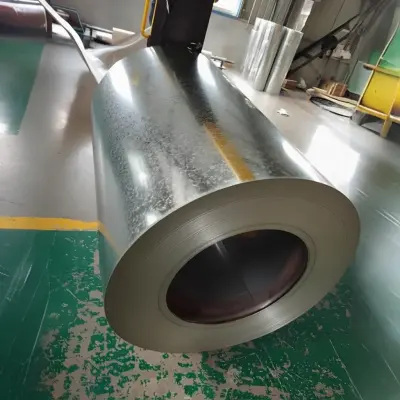
PPGI Steel Coil, also called prepainted galvanized steel coil or color-coated galvanized steel, is produced by applying an organic coating to a hot-dip galvanized steel substrate in a continuous coil-coating line. The typical production sequence includes substrate cleaning, chemical pretreatment, primer application, finish-coat application, controlled curing, cooling, inspection, and recoiling. This continuous process provides a more uniform coating than painting individually fabricated components.
The galvanized substrate provides sacrificial corrosion protection, while the paint layers add color, surface protection, and application-specific performance. A conventional coating structure consists of a top finish coat over primer on the exposed side, with a back coat or primer system on the reverse side. The exact layer configuration should be confirmed in the purchase specification because coating design varies by forming requirement, service environment, warranty conditions, and end use.
Common finish systems include polyester, silicon-modified polyester, high-durability polyester, polyvinylidene fluoride, and polyurethane-based coatings. These paint-system names describe broad technology families rather than identical performance levels. Resin formulation, pigment selection, pretreatment, primer compatibility, film thickness, curing conditions, and exposure environment all affect durability. A purchaser should therefore evaluate documented test performance and the coating supplier's technical data instead of selecting PPGI Steel Coil by paint abbreviation alone. Related coated-steel options can be compared at [[INTERNAL_LINK]].
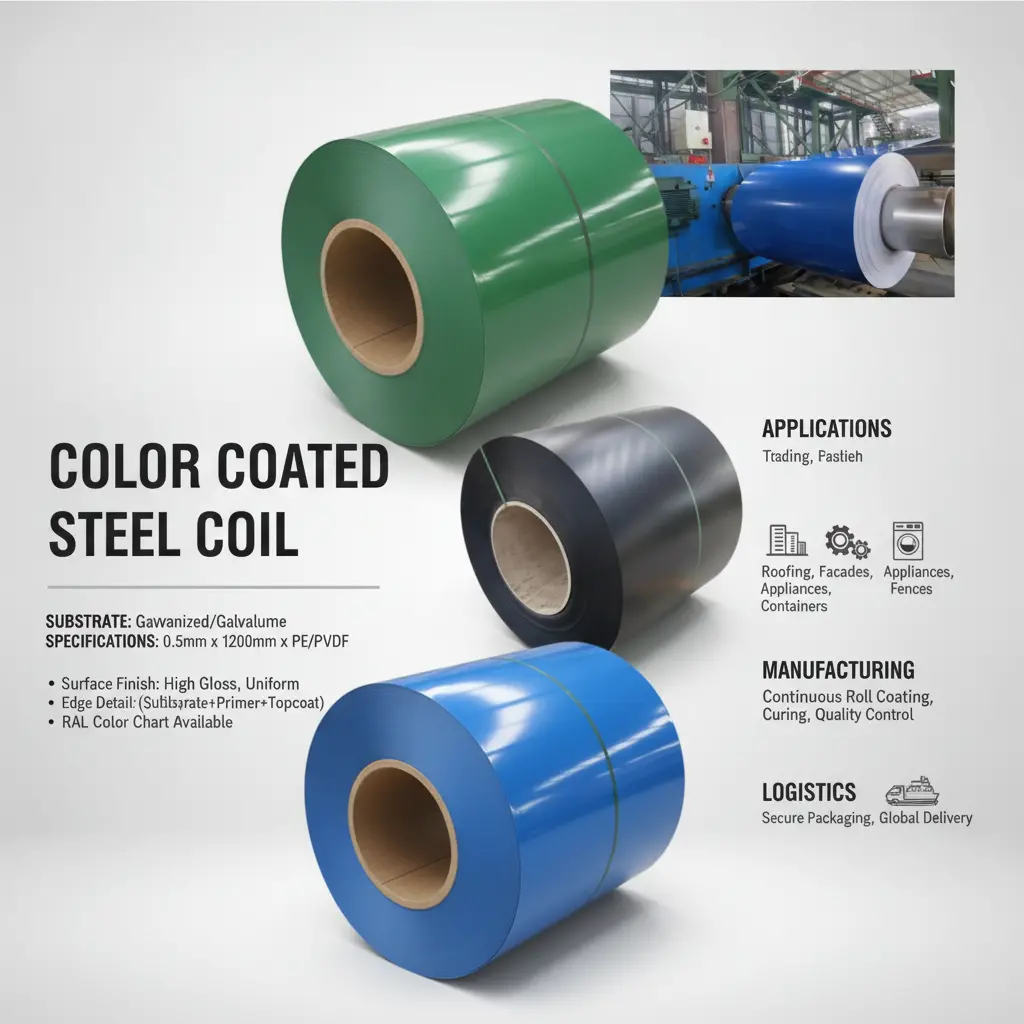
PPGI is distinct from PPGL, which generally uses an aluminum-zinc alloy-coated substrate instead of a conventional galvanized substrate. It also differs from unpainted galvanized coil because PPGI arrives with an industrially applied organic finish. For exposed construction applications, this combination can shorten processing steps and improve batch-to-batch appearance, provided that profiles, fasteners, cut edges, drainage details, and installation practices are compatible with the selected material. Guidance on galvanized substrates is available at [[INTERNAL_LINK]].
PPGI Steel Coil Specifications & Standards
PPGI Steel Coil specifications must define more than color and thickness. A technically complete inquiry normally states the governing standard, base-metal grade, metallic coating designation, nominal steel thickness, width, coil dimensions, paint system, coating structure, color reference, gloss range, surface finish, intended forming method, inspection documents, and packaging requirements.
International specifications commonly used for prepainted and metallic-coated sheet include ASTM A755/A755M, EN 10169, JIS G 3312, and GB/T 12754. The galvanized substrate may also be specified with reference to ASTM A653/A653M, EN 10346, JIS G 3302, or the relevant substrate provisions connected with the selected finished-product standard. These standards are not automatically interchangeable. Grade designations, test methods, coating classifications, tolerances, and ordering terminology differ, so the contract should identify one primary standard and list any additional project requirements separately.
| Specification Item | Buyer-Defined Options | Procurement Note |
|---|---|---|
| Product standard | ASTM A755/A755M, EN 10169, JIS G 3312, or GB/T 12754 | Select the standard required by the destination market, project, or customer drawing. |
| Galvanized substrate | Referenced grade and metallic-coating designation under the applicable standard | Do not substitute grades based only on similar yield-strength descriptions. |
| Steel thickness | Nominal base-metal thickness or coated-product thickness, as agreed | State the measurement basis to prevent ambiguity caused by metallic and organic coatings. |
| Width and tolerance | Mill width, slit width, or roll-forming feed width | Confirm tolerance, edge condition, camber, and slit-width requirements. |
| Metallic coating | Zinc-coating designation appropriate to the chosen standard | Use the designation from the governing standard rather than an informal description. |
| Paint system | Polyester or another agreed coating technology | Select according to UV exposure, corrosion category, forming severity, and expected service conditions. |
| Coating structure | Primer, finish coat, and reverse-side coating as specified | Identify required dry-film thickness and test method in the order document. |
| Color and appearance | Agreed color code or approved physical sample; smooth, textured, matte, or other finish | A color code alone may not define gloss, texture, or permissible visual variation. |
| Coil parameters | Coil weight, internal diameter, external-diameter limit, and winding orientation | Match the receiving line's loading capacity, mandrel, decoiler, and handling equipment. |
| Protection and packing | Protective film where suitable, export wrapping, edge protection, and identification labels | Packaging should reflect the route, handling frequency, storage period, and local climate. |
Chemical composition and mechanical properties belong primarily to the ordered substrate grade. They cannot be stated responsibly without a specific grade and standard because structural, commercial, drawing, and forming grades have different limits. For each order, the manufacturer's inspection document should report the relevant values and test results against the selected specification. Buyers that require yield strength, tensile strength, elongation, hardness, bend performance, or drawing quality should place those requirements on the inquiry rather than relying on a generic PPGI description.
| Performance Category | How It Should Be Specified | Typical Verification |
|---|---|---|
| Chemical composition | By the ordered substrate grade under the chosen ASTM, EN, JIS, or GB/T standard | Heat or cast analysis shown on the applicable inspection document |
| Yield and tensile properties | By substrate grade and product thickness | Tensile testing under the governing standard and referenced test method |
| Formability | According to the intended bending, drawing, profiling, or roll-forming operation | Bend, adhesion, or forming evaluation agreed between purchaser and supplier |
| Paint-film performance | Required dry-film thickness, gloss, color tolerance, adhesion, and other agreed criteria | Coil-coating inspection and tests required by ASTM A755/A755M, EN 10169, or the selected specification |
For architectural work, the sample-approval process is especially important. Color should be evaluated together with gloss, surface texture, viewing angle, and lighting. If several coils will be installed on one visible elevation, buyers should request production and traceability controls suitable for visual consistency. More information about coating inspection and color matching is available at [[INTERNAL_LINK]].
PPGI Steel Coil Applications
PPGI Steel Coil is used where a formed steel component needs a finished appearance and protection from atmospheric exposure. The correct substrate and paint system depend on the severity of forming, the local environment, maintenance expectations, and whether the surface will be visible after fabrication.
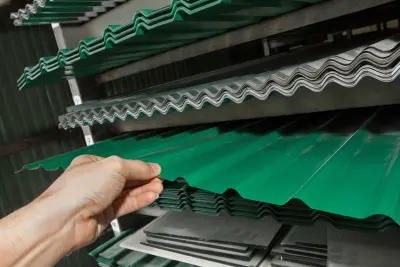
- Roofing and wall cladding: Roll-formers process color-coated galvanized coil into corrugated sheets, trapezoidal profiles, tiles, flashings, gutters, and facade panels. Coating selection should consider UV radiation, rainfall, condensation, pollutants, coastal salts, roof pitch, and building-envelope design. Roofing profile guidance can be reviewed at [[INTERNAL_LINK]].
- Sandwich panels and insulated building systems: PPGI Steel Coil can form the external or internal facing of panels used in industrial buildings, warehouses, cold-storage facilities, and modular structures. Adhesive compatibility, lamination conditions, surface cleanliness, and reverse-side coating must be agreed with the panel producer.
- Appliances and manufactured equipment: Prepainted sheet may be used for cabinets, casings, panels, and other formed components. Procurement teams should define appearance, scratch resistance, forming radius, cleaning resistance, and compatibility with stamping or assembly processes.
- Doors, shutters, ceilings, and interior panels: Manufacturers use PPGI for roller-shutter slats, door skins, partition systems, suspended ceilings, and decorative panels. Flatness, color consistency, surface texture, and edge quality are often critical for these visible products.
- HVAC and general fabrication: Color-coated material can be used for selected ducting accessories, housings, enclosures, and light-gauge fabricated parts. The coating must tolerate the intended cutting, bending, fastening, and service temperature without unacceptable cracking or loss of adhesion.
PPGI should not be treated as universally suitable for every aggressive atmosphere. Constant wetness, chemical fumes, marine exposure, high temperature, contact with incompatible materials, and poor drainage can shorten coating life. Project-specific environmental assessment remains necessary, especially where long design life or formal warranty coverage is required. Application-specific material comparisons are provided at [[INTERNAL_LINK]].
How to Choose PPGI Steel Coil / Buying Guide
PPGI Steel Coil purchasing should begin with the finished component, not with a color chart. A procurement manager needs to translate the application into measurable order requirements and ensure that the supplier's offer uses the same terminology. The following points help reduce technical disputes, processing interruptions, and avoidable logistics costs.
1. Define the substrate and forming requirement
State whether the material will be corrugated, roll-formed, bent, stamped, laminated, or cut into flat sheets. Tight bends and deep profiles place different demands on the steel grade and paint film. Provide drawings, minimum bend radii, profile geometry, and trial requirements where the forming operation is demanding. A stronger grade is not automatically more formable, so mechanical strength and fabrication behavior must be considered together.
2. Specify dimensions on a clear measurement basis
List nominal thickness, acceptable tolerance, width, edge condition, and coil dimensions. Clarify whether thickness refers to base metal, metallic-coated steel, or the complete prepainted product. Also specify coil internal diameter, maximum external diameter, and acceptable coil weight according to the buyer's decoiling equipment. For slit coils, include slit-width tolerance, burr direction where relevant, and permitted camber. Coil-handling recommendations can be found at [[INTERNAL_LINK]].
3. Match the coating system to the environment
Give the supplier the end-use location, indoor or outdoor exposure, proximity to industrial or marine contaminants, UV intensity, temperature range, and expected maintenance conditions. Ask for the coating manufacturer's technical data and documented test criteria. Avoid assuming that two products carrying the same generic resin label will deliver identical weathering, flexibility, or chemical resistance.
4. Confirm color, gloss, texture, and sample approval
Provide an internationally recognized color reference where applicable, but approve a physical sample when appearance is commercially important. Define the target gloss range, measurement method, surface texture, and acceptable color tolerance. For repeat orders, reference the previous approved sample and discuss batch management. Metallic or special-effect finishes may show greater visual variation than solid colors and require additional agreement.
5. Review certification and traceability
Request the inspection documentation required by the contract and destination market. Depending on the order, this may include a manufacturer-issued test certificate or an inspection document prepared according to an agreed type under EN 10204. The purchase order should identify exactly which document is required; the phrase “mill certificate” can be interpreted differently. Confirm coil identification, heat or batch traceability, coating records, and any third-party inspection requirement before production.
6. Agree MOQ and lead time before commercial approval
Minimum order quantity is influenced by steel grade, thickness, width, paint type, color, coating structure, and production scheduling. Standard combinations may have different availability from customized colors or uncommon dimensions. Because no universal MOQ or lead time applies to all PPGI Steel Coil orders, buyers should request confirmation for the exact specification and quantity. Include time for sample approval, production, inspection, packaging, and inland transport in the procurement schedule.
7. Plan export packaging and logistics
Coils are dense cargo and require equipment capable of safe lifting, blocking, and securing. Tell the supplier whether the shipment will move by container, truck, rail, or breakbulk service, as well as any limits on package weight and dimensions. Packaging should protect the coil faces, edges, and bore from handling damage and moisture exposure. Buyers should also arrange dry storage and avoid prolonged contact with trapped water, which can affect metallic and painted surfaces. Export-packing considerations are discussed at [[INTERNAL_LINK]].
8. Compare offers line by line
Normalize quotations before comparing price. Check the governing standard, grade, thickness basis, width tolerance, zinc-coating designation, top and back coating, paint technology, film specification, color, gloss, coil weight, certification, packaging, Incoterm, delivery schedule, and payment conditions. A lower quoted unit price may reflect a materially different specification, so commercial comparison is meaningful only after technical alignment.
PPGI Steel Coil Frequently Asked Questions
Q: What is the difference between PPGI Steel Coil and galvanized steel coil?
A: Galvanized steel coil has a zinc coating over the steel substrate but is generally supplied without a factory-applied decorative organic finish. PPGI Steel Coil uses galvanized steel as its substrate and adds pretreatment, primer, and finish-paint layers. The additional layers provide color and application-specific surface properties while the zinc layer continues to protect the underlying steel. The correct choice depends on whether the finished part will be painted after fabrication or requires a ready-finished surface.
Q: What is the difference between PPGI and PPGL?
A: PPGI normally refers to prepainted galvanized steel, while PPGL commonly refers to prepainted aluminum-zinc alloy-coated steel. Their substrate coatings have different compositions and may behave differently in particular environments, at cut edges, and during processing. Product names alone are insufficient for substitution. Buyers should compare the exact metallic-coating standard, coating designation, steel grade, paint system, forming requirement, and supplier recommendations. A detailed PPGI and PPGL comparison is available at [[INTERNAL_LINK]].
Q: Which standards apply to PPGI Steel Coil?
A: Common finished-product standards include ASTM A755/A755M for prepainted metallic-coated steel sheet, EN 10169 for continuously organic-coated steel flat products, JIS G 3312 for prepainted hot-dip zinc-coated steel sheet and strip, and GB/T 12754 for prepainted steel sheet and strip. Galvanized substrates may be associated with ASTM A653/A653M, EN 10346, or JIS G 3302. The purchase contract should state one governing standard because classifications and requirements are not identical.
Q: Can the supplier provide material certification and third-party inspection?
A: Certification should be agreed during quotation. Buyers can request an inspection document that identifies the ordered grade, dimensions, metallic coating, and relevant test results. Where EN 10204 documentation is needed, the required document type must be stated clearly. Independent inspection may also be arranged when required by the contract, project owner, financing terms, or import procedure. Inspection scope, sampling, acceptance criteria, access, and cost allocation should be confirmed before production.
Q: What is the minimum order quantity for PPGI Steel Coil?
A: There is no single industry-wide MOQ. The practical quantity depends on whether the requested substrate, width, thickness, color, paint system, and coating structure are standard production items or require a dedicated run. Customized colors and less common specifications may require a different production quantity from regularly scheduled products. Send a complete specification and destination so the manufacturer can confirm the applicable MOQ rather than relying on a general estimate.
Q: How long does production and delivery take?
A: Lead time depends on raw-material availability, color matching, sample approval, production-line scheduling, order volume, inspection, packaging, and the selected shipping route. Custom coating systems or approval samples can add time before mass production starts. The supplier should confirm an estimated production period only after reviewing the final technical specification. Ocean or inland transit should be treated separately from manufacturing lead time, and seasonal logistics constraints should be considered in the delivery plan.
Q: Which payment methods are available for export orders?
A: Payment terms are negotiated for each transaction and may depend on order value, buyer credit assessment, destination, production customization, and trade-finance requirements. Common international arrangements can include bank transfer and documentary letter of credit, subject to mutual agreement. Buyers should confirm deposit requirements, balance-payment timing, banking charges, document presentation rules, and the relationship between payment milestones and shipment before issuing the purchase order.
Q: How should I select the correct paint system?
A: Start with the actual exposure conditions and forming process. Provide information about indoor or outdoor use, UV exposure, humidity, industrial pollution, coastal influence, cleaning chemicals, temperature, required appearance, and expected service period. Then compare coating data for flexibility, adhesion, weathering, corrosion resistance, gloss retention, and chemical resistance using agreed test methods. The final selection should reflect both environmental demands and the coating's ability to withstand fabrication.
Q: Can PPGI Steel Coil be supplied in custom colors and surface finishes?
A: Custom colors, gloss levels, and textures may be available, but feasibility depends on the paint system, production quantity, and line capability. A color reference should be supported by an approved sample where visual matching is important. Buyers should also define whether protective film is required and confirm that the film is compatible with forming, storage, and removal conditions. Special finishes may require additional sample approval and production planning.
Q: What information is needed for an accurate PPGI quotation?
A: Provide the applicable standard, substrate grade, zinc-coating designation, thickness and measurement basis, width, quantity, coil dimensions, paint technology, top and reverse-side coating requirements, color reference, gloss, texture, intended application, certification, packaging, destination, and preferred Incoterm. Include drawings or profile details for demanding forming work. A complete request allows the manufacturer to evaluate production feasibility and issue a commercially comparable quotation.
Send your required PPGI Steel Coil standard, grade, dimensions, metallic coating, paint system, color, coil parameters, order quantity, certification needs, and delivery destination to request a technical review and quotation. The specification can be checked for production compatibility before commercial terms are finalized, helping your procurement team compare an offer based on clearly defined material, inspection, packaging, and logistics requirements.
Ratings & Reviews

Know your supplier
Supplier's customization ability
- Drawing-based customization
- Sample-based customization
- Full customization
Minimum order quantity: 25 ton
Shipping total: To be negotiated
- Lead time:
- confirmed with the quotation
- Packaging:
- standard export packing
- Samples:
- available on request